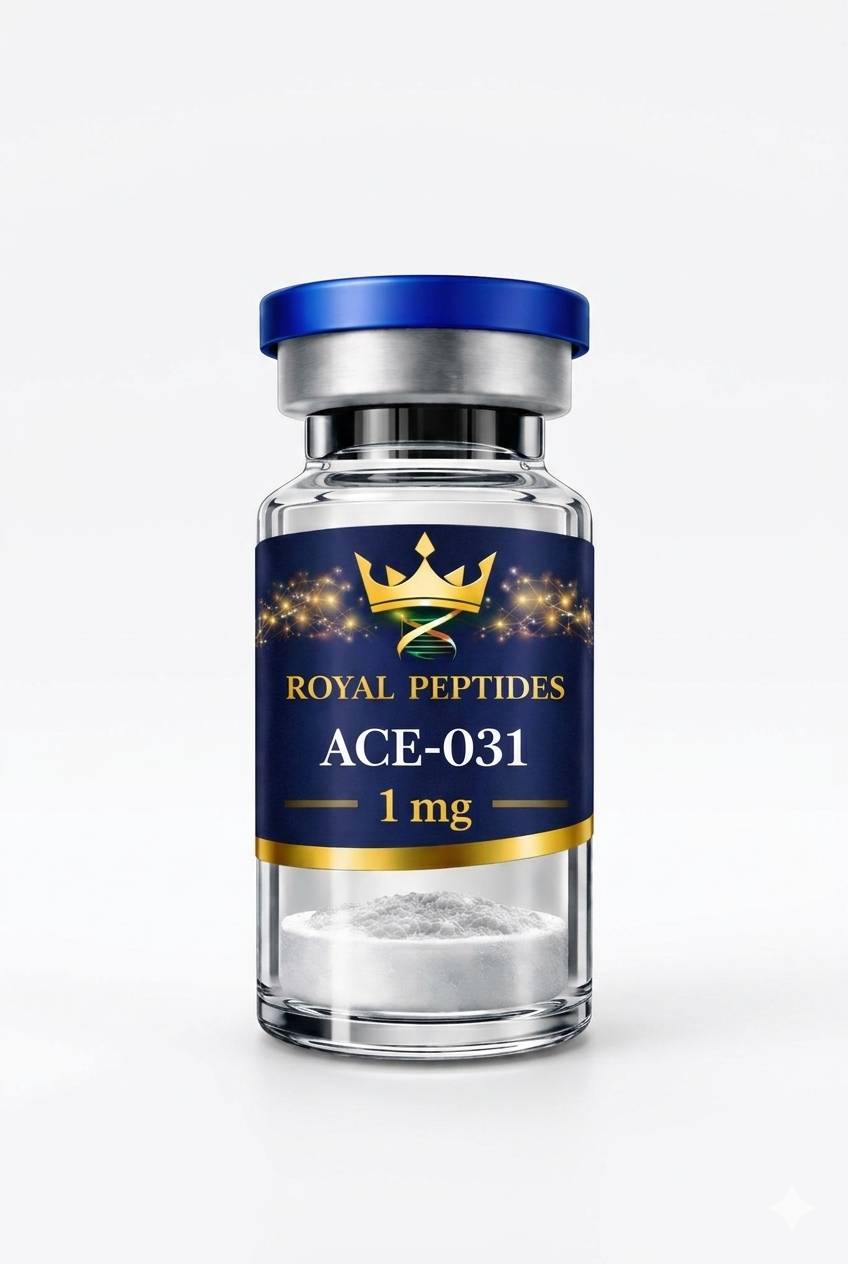
Description
ACE-031 (AE1) – a research recombinant fusion protein focused on muscle growth regulation and TGF-β signaling
ACE-031 (AE1) is a recombinant fusion protein developed as an experimental tool for studying muscle mass regulation through modulation of signaling pathways within the TGF-β (transforming growth factor beta) superfamily. In preclinical and experimental models, it is primarily investigated in the context of myostatin inhibition and related activin-type ligands involved in the regulation of skeletal muscle growth and differentiation.
It belongs to a class of biologically active molecules studied in relation to molecular control of muscle hypertrophy, cellular proliferation, and metabolic adaptation of muscle tissue.
Why ACE-031 Is a Subject of Research
ACE-031 enables researchers to analyze muscle mass regulatory mechanisms at the level of receptor binding and downstream intracellular signaling. It is primarily studied in relation to:
• inhibition of myostatin signaling
• modulation of activin type IIB receptors (ActRIIB)
• regulation of myoblast differentiation and proliferation
• mechanisms of skeletal muscle hypertrophy
• metabolic adaptation of skeletal muscle tissue
• interactions between growth factors and extracellular signaling pathways
In experimental models, it serves as a research tool for investigating biological processes influencing muscle volume, structural organization, and functional capacity.
Mechanism of Action (Research Context)
ACE-031 is engineered as a fusion protein containing the extracellular domain of the ActRIIB receptor, capable of binding ligands belonging to the TGF-β superfamily, including myostatin. By binding these ligands, their biological availability may be reduced, leading to modulation of downstream signaling cascades, particularly SMAD-dependent pathways.
Laboratory research suggests that molecules of this type may influence:
• gene expression involved in muscle growth regulation
• the balance between protein synthesis and proteolysis
• differentiation of muscle satellite cells
• signaling pathways regulating the cell cycle
• structural organization of muscle fibers
These mechanisms are significant for understanding molecular regulation of muscle mass under experimental conditions.
Areas of Research Application
ACE-031 is primarily utilized in:
• research on skeletal muscle hypertrophy regulation
• molecular biology of skeletal muscle tissue
• studies of TGF-β and myostatin signaling pathways
• cellular differentiation and myoblast proliferation models
• experimental models of muscle atrophy and adaptation
Research Background and Scientific References
Research on myostatin inhibition and ActRIIB signaling is supported by extensive scientific literature on muscle growth regulation:
1️⃣ Lee S.J.
Regulation of muscle mass by myostatin
Annual Review of Cell and Developmental Biology
→ Role of myostatin in muscle mass regulation.
2️⃣ McPherron A.C. et al.
Regulation of skeletal muscle mass in mice by a new TGF-beta superfamily member
Nature
→ Identification and biological function of myostatin.
3️⃣ Emerging research on ActRIIB inhibitors
Preclinical models investigating SMAD signaling modulation and skeletal muscle hypertrophy.
Safety and Regulatory Information
⚠️ Important Notice:
ACE-031 is intended strictly for laboratory and research purposes.
It is not approved as a medicinal product.
It is not intended for human or veterinary use.
It is not intended for consumption or clinical applications.
The product is distributed exclusively to research institutions, laboratories, and professional experimental use.
All products available in our offer are intended strictly for research, laboratory, and development purposes only. They are not intended for use as a medicinal product, medical device, cosmetic product, food, dietary supplement, or as an active substance intended for consumption or application in humans or animals.
These products are not approved for clinical use and must not be used for the diagnosis, treatment, or prevention of any disease.
By purchasing the product, the customer acknowledges and confirms understanding of its research nature and agrees to use it exclusively in accordance with this intended purpose.
The purchase of our products is permitted only to individuals over 18 years of age.
Product images are for illustrative purposes only. The actual appearance of the packaging may vary depending on the current batch.