Applications of Peptides in the Modern World — From Laboratory to Medicine and Beyond
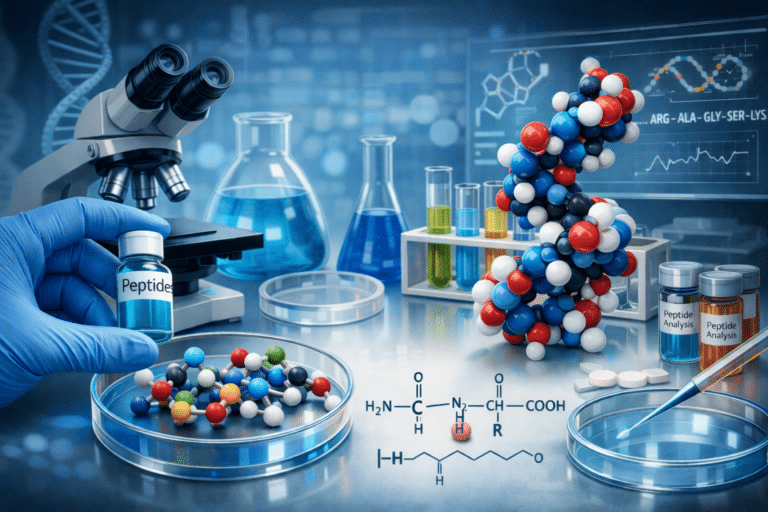
Peptides, short chains of amino acids, today represent one of the most flexible and promising types of biologically active molecules. Their importance is no longer limited to scientific laboratories. From pharmaceuticals and cosmetics to areas that are strictly regulated or even controversial, peptides have become a widespread tool of modern biology. This article provides an overview of where and how peptides are used today, how they are produced, and what trends we can expect in their future development.
Peptides in Science and Research
Modern scientific research is practically unimaginable without peptides. They serve as tools for studying cellular communication, metabolism, tissue regeneration, and immunology. Their use in research is based on their ability to precisely modulate biological processes, allowing scientists to test hypotheses and discover new mechanisms.
Examples of research applications:
• testing receptor–ligand interactions
• studying cellular signaling pathways
• development of disease models
• development of therapeutic candidates
Their small size and biological compatibility allow researchers to quickly create peptide variants and study the effects of specific modifications.
Pharmaceuticals and Healthcare — Peptides as Therapeutics
One of the most significant fields is medical research and pharmaceutical development. Peptides are used as drugs or as components of therapeutic molecular systems. Their targeting precision reduces the risk of side effects and allows biological processes to be modulated so the body responds naturally and effectively.
Clinical applications:
• hormones and hormone analogues – insulin, GLP-1 analogues
• tissue regeneration and healing – peptide factors stimulating cell growth
• immune modulation – antimicrobial peptides, immune activators
• oncology – peptides targeting tumor cells or delivering therapeutic agents
An advantage is that peptides are often biologically compatible, which means lower toxicity and a reduced risk of complications compared to some chemical drugs. Their flexibility also enables personalized medicine, where peptides are designed specifically for individual patients.
Cosmetics and Wellness
In recent years, peptides have also become popular in the cosmetic industry. Their effect in this sector mainly lies in their ability to signal and modulate skin cells, stimulate collagen production, and improve skin renewal.
Common applications:
• anti-aging products
• peptide serums supporting skin regeneration
• products improving elasticity and hydration
• topical treatments for wounds and scars
The cosmetics market is increasingly investing in peptide research aimed at developing molecules capable of targeted biological effects while maintaining safety and stability.
Peptide Synthesis — In the Laboratory and Industry
Peptides can be obtained in two primary ways: biologically or chemically.
Biological synthesis
• In living organisms, peptides are produced on ribosomes according to genetic information
• After synthesis, post-translational modifications often follow (e.g., cleavage, cyclization, chemical modifications)
• Advantage: biological authenticity
• Disadvantage: more complex isolation and lower design flexibility
Chemical synthesis
• The most widely used method: solid-phase peptide synthesis (SPPS)
• The peptide chain is built step by step by attaching amino acids to a solid support
• After completion, the peptide is released and purified (HPLC, chromatography)
• Enables precise design, modifications, stabilization, and automation
Chemical synthesis is essential for pharmaceutical and cosmetic industries where high precision, purity, and reproducibility are required.
Controversial and Prohibited Areas
Peptides also appear in areas that are strictly regulated or banned, particularly in sports and doping practices. Some peptides stimulate the production of growth hormone or modulate metabolism, which can lead to unethical or dangerous uses.
Regulations are strict:
• WADA (World Anti-Doping Agency) bans many peptides for athletes
• Unauthorized peptide preparations may have unpredictable side effects
• Scientific oversight and monitoring are essential for safe applications
This aspect highlights that molecules capable of altering the human body also carry responsibility and require strict oversight.
The Future of Peptides
The development of peptides continues to accelerate thanks to advanced synthetic methods, analytical technologies, and digital design. Current trends indicate:
• personalized medicine – peptides tailored to individual patients
• targeted drug delivery – minimizing side effects
• new therapeutic areas – neurodegenerative diseases, metabolic disorders, immunotherapy
• next-generation cosmetics – biologically active peptide complexes
Peptides are not only scientific discoveries but also tools of the future capable of precisely influencing human health and physiology. Their potential is enormous, not only in medicine but also in biotechnology and cosmetics.
Conclusion
Today, peptides connect science, medicine, cosmetics, and even controversial fields into a single multidisciplinary domain. Their versatility, biological compatibility, and precision make peptides powerful tools that are transforming how we approach treatment, regeneration, and aesthetics. From the laboratory and the clinic to cosmetic products, peptides are everywhere — and their importance will continue to grow.
Those who understand and apply them safely gain not only scientific knowledge but also the potential to improve human lives.
Sources
• Nelson & Cox — Lehninger Principles of Biochemistry
• Alberts et al. — Molecular Biology of the Cell
• Merrifield RB — Solid Phase Peptide Synthesis (Nobel Lecture)
• Craik DJ et al. — Peptide drug discovery (Nature Reviews Drug Discovery)
• Fosgerau & Hoffmann — Peptide therapeutics: current status and future directions (Drug Discovery Today)
• Hancock REW — Antimicrobial peptides (Nature Biotechnology)