How Peptides Are Produced and Where — From Laboratory to Industrial Manufacturing
Peptides are now among the most sought-after biologically active molecules in science, pharmaceuticals, and cosmetics. Their precise synthesis, quality control, and safe distribution are essential for the success of research projects and clinical applications. In this article, we will explore how peptides are produced, where and by whom they are manufactured, which technologies are used, and what standards apply to packaging and transport.
Peptides: From Concept to Molecule
Peptides are short chains of amino acids connected by peptide bonds. Today, their production mainly occurs in two ways:
1. Biological synthesis – using cellular systems to produce peptides based on genetic information.
2. Chemical synthesis – laboratory creation of peptides through controlled chemical reactions.
Each of these approaches has its advantages and limitations, and the choice of method depends on the peptide’s purpose, size, stability, and final application.
Where Peptides Are Produced
1. Research laboratories
• University and scientific laboratories synthesize peptides to study biological mechanisms.
• Smaller quantities are typically produced here, often only milligrams to grams.
• Laboratories use automated solid-phase synthesizers (SPPS), analytical instruments (HPLC, MS), and specialized air purification systems to minimize contamination.
2. Industrial laboratories and pharmaceutical companies
• Pharmaceutical companies produce peptides in GMP (Good Manufacturing Practice) environments regulated by governmental authorities.
• Production for clinical trials and commercial use takes place in facilities with controlled temperature, humidity, and air purity.
• Many peptides are manufactured on demand (custom peptides), while others are produced at scale for pharmaceuticals, supplements, or cosmetics.
3. Specialized peptide companies
• Some companies specialize exclusively in peptide synthesis, purification, and distribution.
• These companies often provide additional services such as peptide labeling, modified sequence design, or customized packaging based on client requirements.
Chemical Production of Peptides: Step by Step
Solid-phase peptide synthesis (SPPS)
The most widely used method, developed by Robert Bruce Merrifield in the 1960s. The process includes:
1. Anchoring the first amino acid to a solid support.
2. Gradually adding additional amino acids using protecting groups to prevent unwanted reactions.
3. Activating the carboxyl group of each amino acid so it reacts with the previous one.
4. Releasing the peptide from the support once the chain is complete.
5. Purification using HPLC and verification of identity and purity through analytical methods (mass spectrometry, amino acid analysis).
Advantages of SPPS:
• precise sequence control
• ability to introduce chemical modifications
• potential for automation
• production of very long peptide chains
Solution-phase synthesis
• Used mainly for special modifications and cyclic peptides.
• Reactions occur in solution, allowing greater flexibility for chemical modifications.
• Disadvantage: more complex purification and isolation.
Biological Peptide Synthesis
• Peptides can also be produced using recombinant cellular systems (bacteria, yeast, or mammalian cells).
• The gene encoding the peptide is inserted into a host cell, which then produces the target molecule.
• After synthesis, the peptide is isolated and purified.
• This approach is used for large-scale production of biologically active peptides such as insulin, growth factors, or therapeutic peptides for clinical applications.
Purity and Quality Control
In peptide production, purity is essential. Every molecule must be carefully verified:
• HPLC – determination of purity
• Mass spectrometry (MS) – confirmation of molecular weight
• Sequence analysis – verification of amino acid sequence
• Spectroscopic methods – structural characterization
In GMP environments, documentation of every batch is mandatory to ensure reproducibility and safety.
Packaging and Transport
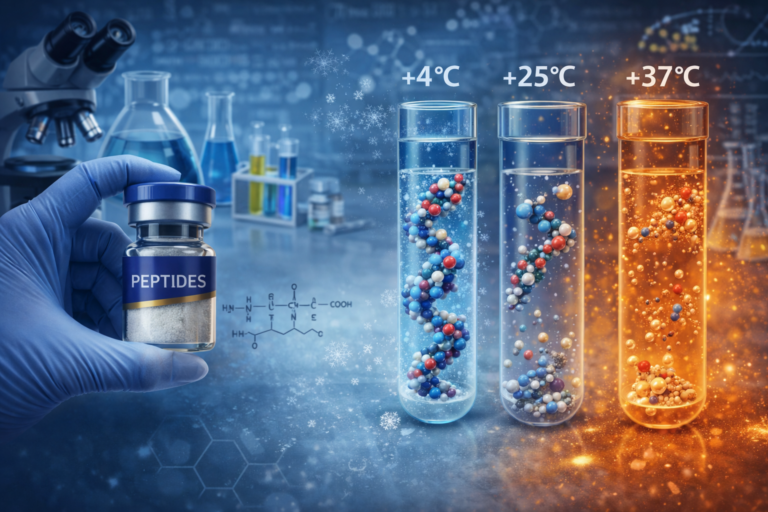
Peptides are sensitive molecules that may degrade:
• chemically (oxidation, hydrolysis)
• enzymatically (proteases)
• physically (heat, light, humidity)
Therefore, they are packaged and transported using specialized methods:
• Lyophilization (freeze-drying) – stabilizing the peptide
• Hermetic packaging – protection against moisture
• Refrigerated transport – maintaining low temperatures
• Transport monitoring – tracking temperature and humidity
These measures ensure that the peptide reaches the customer in the same quality in which it left the laboratory.
Who Produces Peptides
• Pharmaceutical giants – production of therapeutic peptides for mass distribution
• Specialized peptide companies – production of custom sequences for research
• Academic laboratories – small quantities for scientific research
• Biotechnology startups – innovation and development of new peptide-based therapeutics
Each type of producer follows strict standards to ensure the quality and safety of the molecules.
The Future of Peptide Production
• Automation and robotics – faster and more precise synthesis
• Digital peptide design – tailoring molecules for specific targets
• Green chemical processes – more environmentally friendly production
• Greater personalization – individualized therapeutic peptides
Peptide production is becoming not only more efficient but also more intelligent — processes are monitored, controlled, and optimized to achieve maximum quality and safety.
Conclusion
Peptides are produced today in various environments — from university laboratories and specialized companies to pharmaceutical giants. Their synthesis involves a combination of chemical and biological methods, precise quality control, and careful packaging and transportation. Thanks to these processes, peptides have become safe, effective, and versatile molecules used in research, medicine, and cosmetics.
Their future is promising — automation, digital design, and personalized medicine are opening possibilities that only a few decades ago seemed like science fiction. Peptides are not only molecules in the laboratory but tools that are transforming medicine and human health worldwide.
Sources
• Nelson & Cox — Lehninger Principles of Biochemistry
• Alberts et al. — Molecular Biology of the Cell
• Merrifield RB — Solid Phase Peptide Synthesis (Nobel Lecture)
• Craik DJ et al. — Peptide drug discovery (Nature Reviews Drug Discovery)
• Fosgerau & Hoffmann — Peptide therapeutics: current status and future directions (Drug Discovery Today)