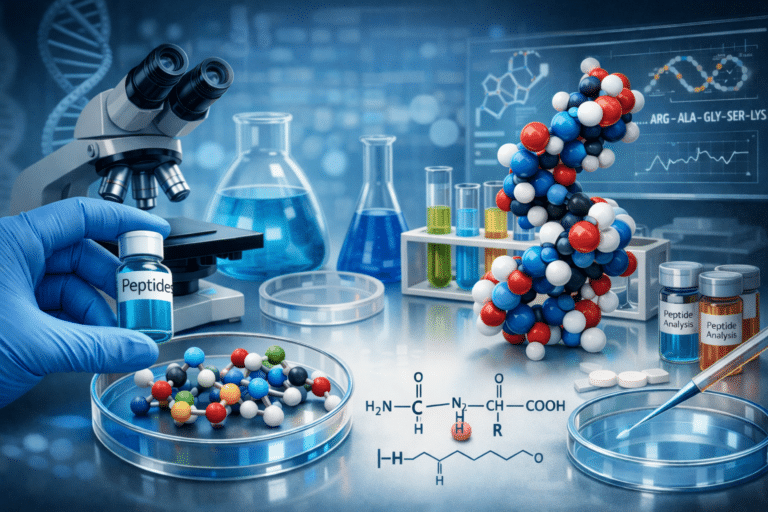
Peptides are biologically active molecules whose effectiveness depends directly on their structure. Unlike many simpler chemical compounds, peptides are highly sensitive to environmental conditions. Temperature, humidity, pH, and light can significantly affect their stability and, consequently, their biological activity.
Peptide stability is therefore not just a matter of logistics or storage. It is a critical factor that determines whether a molecule remains functional, becomes degraded, or even potentially harmful.
What peptide stability means
Stability refers to the ability of a peptide to maintain its chemical structure and biological function over time.
Instability may lead to:
-
peptide bond breakdown
-
oxidation
-
deamidation
-
aggregation
-
isomerization
Why peptides are sensitive
Peptides consist of amino acids linked by peptide bonds, which can be disrupted under real-world conditions.
Temperature impact
Higher temperatures:
-
accelerate reactions
-
increase degradation
Storage:
✔ refrigeration (2–8 °C)
✔ freezing (-20 °C)
Humidity impact
Moisture can trigger hydrolysis.
Light impact
Light can cause degradation and oxidation.
pH impact
Extreme pH destabilizes peptides.
Lyophilization
Improves stability by removing water.
After reconstitution
Stability decreases rapidly.
Contamination
Can degrade peptides and pose risks.
Why stability matters
Unstable peptides:
-
lose effectiveness
-
may be unsafe
Stability testing
Includes environmental and time-based studies.
Regulation
✔ GMP
✔ ICH
Conclusion
Peptide stability is essential for safety, effectiveness, and reliability.
Sources
Nelson & Cox — Lehninger Principles of Biochemistry
Alberts et al. — Molecular Biology of the Cell
ICH Q1A(R2) — Stability Testing of New Drug Substances and Products
FDA — Guidance for Industry: Stability Testing of Drug Substances and Drug Products
EMA — Guideline on Stability Testing of New Drug Substances and Products
Fosgerau & Hoffmann — Peptide therapeutics: current status and future directions (Drug Discovery Today)
Manning MC et al. — Stability of protein pharmaceuticals (Pharmaceutical Research)
Wang W — Instability, stabilization, and formulation of liquid protein pharmaceuticals (Int. J. Pharmaceutics)