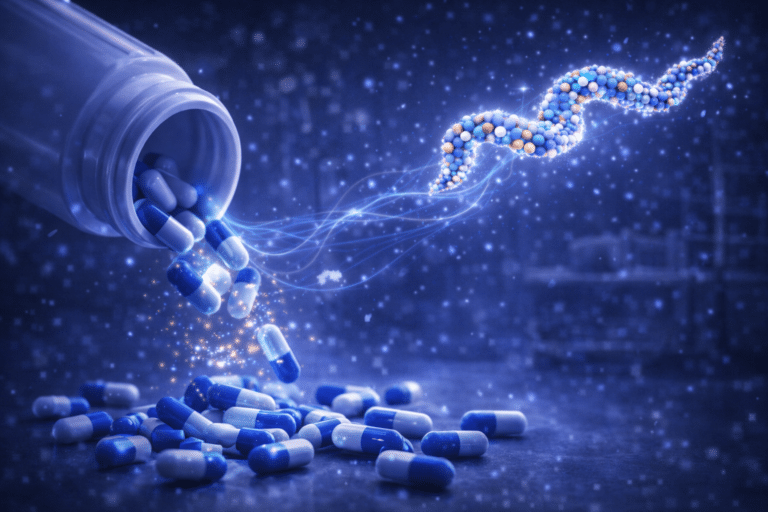
What Are Peptides? — Small Molecules with Great Potential for Modern Medicine
Peptides are among the most actively studied molecules in modern biomedicine. Gradually moving from laboratory studies into clinical applications, diagnostics, and advanced therapeutic approaches, they are considered by scientists to be one of the most promising classes of biologically active compounds — not because they are “trendy,” but because they can communicate with the human body at the cellular level with remarkable precision.
In this article, we present a scientifically grounded yet accessible overview: what peptides are, how they are formed, how they are produced, and why they hold such significant potential for healthcare and the future of personalized medicine.
Basic Definition
Peptides are short chains of amino acids connected by peptide bonds. Amino acids are the building blocks of all proteins in the human body. The difference between a peptide and a protein lies mainly in length and complexity:
• short chains → peptides
• long and structurally complex chains → proteins
Despite their relatively small size, peptides have an exceptionally strong biological impact. They often function as precise signaling molecules that trigger or regulate specific cellular processes.
Simply put: if hormones and proteins are the “control systems,” peptides are often the targeted messages within those systems.
Peptides as the Natural Language of the Body
The human body naturally produces a wide variety of peptides. They are part of the body’s internal communication system.
Examples of natural peptides include:
• peptide hormones
• regulatory signaling molecules
• growth factors
• neuropeptides
• defensive (antimicrobial) peptides
These molecules regulate processes such as metabolism, tissue regeneration, immune response, and cellular signaling. This is why peptide research is so important — it works with mechanisms that the body already understands and uses.
Why Peptides Are a Major Trend in Science
Modern medicine is moving away from broad, unspecific interventions toward precise biological modulation. Peptides fit perfectly into this approach:
• they act specifically
• they bind to precise receptors
• they can be rationally designed
• their behavior can often be predicted
Many research teams see peptides as a bridge between classical small-molecule drugs and large biological proteins. They combine the precision of biologics with the controllability of chemical synthesis.
Historical Development and Scientific Milestones
Peptide science has been developing for more than a century, but its true expansion occurred in the second half of the 20th century.
Key milestones include:
• clarification of the peptide bond structure
• isolation of biologically active peptides
• therapeutic use of insulin
• introduction of solid-phase peptide synthesis
• automated laboratory peptide production
• advanced analytical quality control methods
Today, peptides can be designed with precision — with exact sequences and targeted biological interactions.
How Peptides Are Produced
Biological Synthesis
In living organisms, peptides are produced on ribosomes according to genetic information. This is a natural biological process that is often followed by additional chemical modifications of the molecule.
Laboratory Synthesis
In research environments, the most common method is solid-phase peptide synthesis (SPPS). This technique allows:
• precise sequence control
• high purity
• structural modifications
• stabilization improvements
• labeling for research purposes
Modern synthesis platforms can produce complex peptides with high reproducibility — a key requirement for reliable scientific research.
Analysis and Quality — The Foundation of Reliable Research
In scientific work, producing a peptide is not enough — it must also be precisely verified.
The most common analytical methods include:
• HPLC — measurement of purity
• mass spectrometry — confirmation of molecular mass
• sequence analysis
• structural spectroscopic methods
Without these steps, the material cannot be considered reliable for scientific study. Rigorous analytical validation distinguishes serious research from unverified claims.
Fields of Application — Where Peptides Are Changing the Game
Biomedical Research
Peptides are essential tools for studying:
• cellular signaling
• receptor biology
• metabolic regulation
• tissue regeneration
Pharmaceutical Development
Peptide therapeutics represent a rapidly growing category of medicines. Research shows that properly designed peptides can target biological pathways with high precision.
Advantages include:
• high selectivity
• biological compatibility
• relatively low nonspecific toxicity (compared with some chemical compounds)
Personalized Medicine
Peptides fit naturally into the concept of precision medicine — approaches that are tailored to the specific biological profile of an individual patient.
Applied Research
Peptides are also studied in dermatological and biomaterials research, where they can function as signaling or structural molecular fragments.
A Realistic Perspective: Great Potential, but Scientific Discipline
It is true that peptides have enormous potential and have already produced significant advances in certain areas. However, peptide science requires rigorous methodology, including:
• precise synthesis
• strict quality control
• biological testing
• clinical validation
Serious peptide science is not built on miraculous claims, but on data, analytical rigor, and reproducible results.
Summary
Peptides are short amino acid chains that play a key role in biological communication within the body. Modern science can synthesize, analyze, and study them with remarkable precision. Because of their specificity and biological compatibility, they represent one of the most promising areas of contemporary biomedical research and innovative therapeutic development.
Their strength lies not in “miracles,” but in precision.
References
• Nelson & Cox — Lehninger Principles of Biochemistry
• Alberts et al. — Molecular Biology of the Cell
• Merrifield RB — Solid Phase Peptide Synthesis (Nobel Lecture)
• Craik DJ et al. — Peptide-based drugs (Nature Reviews Drug Discovery)
• Fosgerau & Hoffmann — Peptide therapeutics (Drug Discovery Today)
• Hancock & Sahl — Antimicrobial peptides (Nature Biotechnology)