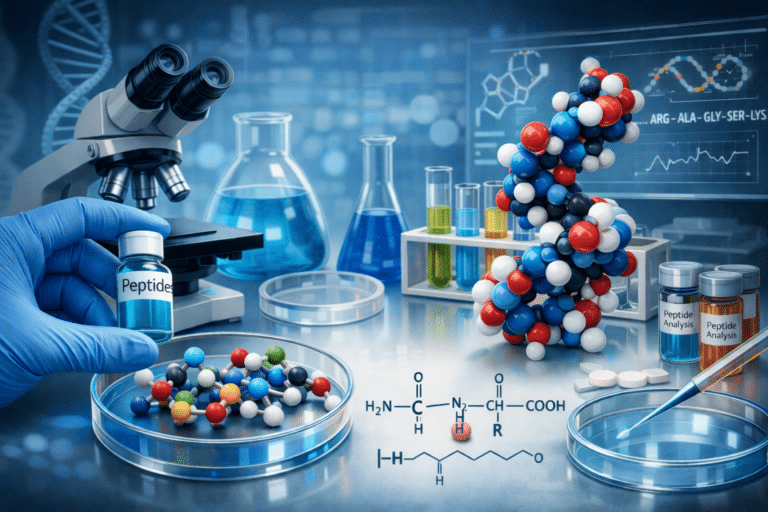
How Peptides Were Discovered — The History of Peptide Science and Its Development
Today, peptides are considered one of the most promising classes of biologically active molecules in research and medicine. However, their story did not begin in modern biotechnology laboratories but in the fundamental study of proteins more than a century ago. The journey from the first chemical experiments to precisely designed synthetic peptides is an example of how patient scientific research gradually becomes a practical tool for healthcare.
This article provides a historical overview: who discovered peptides, how scientific understanding evolved, why scientists began synthesizing them, and how peptides became a significant pillar of modern biomedicine.
The Beginning: Protein Research in the 19th Century
The roots of peptide science go back to the 19th century, when chemists attempted to understand the composition of proteins. At that time, it was already known that proteins were fundamental components of living organisms, but their internal structure remained a mystery.
Scientists gradually discovered that:
• proteins can be broken down into smaller units
• these units are amino acids
• amino acids are connected by a specific type of chemical bond
The study of these bonds led to the concept of the peptide bond — a chemical linkage that holds amino acids together in a chain.
Emil Fischer and the Foundations of Peptide Chemistry
A key figure in the early development of peptide science was Emil Fischer, a German chemist and Nobel Prize laureate (1902). At the turn of the 19th and 20th centuries, he systematically studied amino acids and their connections.
His contributions included:
• experimentally confirming the existence of the peptide bond
• deliberately synthesizing short peptide chains for the first time
• establishing the theoretical foundation for understanding protein structure
Fischer demonstrated that amino acids could be chemically connected into defined sequences. This was a major breakthrough — the first evidence that biological building blocks could also be created artificially.
The Discovery of Biologically Active Peptides
In the first half of the 20th century, attention shifted from purely chemical structure to the biological function of peptides. Scientists began isolating small peptide molecules from tissues and discovered that they had powerful regulatory effects.
Important discoveries included:
• peptide hormones
• digestive regulatory peptides
• neuroactive peptides
• cellular signaling molecules
Researchers realized that short amino acid chains could control complex physiological processes. This fundamentally changed the understanding of biological regulation — not only large proteins but also small, precise molecular signals play key roles.
Insulin — A Breakthrough Moment
One of the most significant milestones was the discovery and isolation of insulin in 1921 (Banting, Best, Collip, Macleod). Insulin is a peptide hormone, and its introduction into diabetes treatment represents one of the greatest medical achievements of the 20th century.
The importance of insulin for peptide science:
• it demonstrated that a peptide could be a life-saving medicine
• it sparked intense interest in peptide hormones
• it accelerated the development of isolation and purification techniques
• it motivated the development of synthetic production methods
Later, insulin also became one of the first peptides produced using biotechnology.
The Problem: Synthesis Was Too Slow
Although scientists knew peptides existed and were biologically active, their laboratory preparation remained extremely difficult for many years. Each synthesis step required purification and isolation of intermediate products. Producing longer peptide chains was slow, expensive, and often inefficient.
This limited:
• experimental research
• sequence testing
• development of therapeutic candidates
The situation changed dramatically in the 1960s.
The Revolution: Solid-Phase Peptide Synthesis
In 1963, American chemist Robert Bruce Merrifield introduced the method of solid-phase peptide synthesis (SPPS). This technological breakthrough transformed the entire field.
Principle:
• the peptide is built on a solid support
• intermediate steps do not require isolation
• the chain grows step by step
• the process can be automated
Consequences:
• dramatically faster synthesis
• higher precision
• improved reproducibility
• the ability to produce longer sequences
Merrifield received the Nobel Prize (1984) for this method. From that moment on, peptide chemistry became practically applicable on a large scale.
The Rise of Analytical Technologies
The development of peptide science was closely linked with advances in analytical techniques. Without them, it would not be possible to confirm molecular identity and purity.
Key technologies include:
• high-performance liquid chromatography (HPLC)
• mass spectrometry
• sequence analysis
• modern spectroscopic methods
These tools enabled researchers to work with precisely defined molecules — the foundation of reliable scientific research.
Why Interest in Peptides Increased Rapidly
Since the late 20th century, interest in peptides has grown rapidly for both scientific and practical reasons:
• high binding specificity
• biological compatibility with the human body
• the possibility of targeted molecular design
• relatively favorable safety profile
• flexibility of chemical modifications
Peptides became an attractive bridge between classical small-molecule drugs and large biological therapeutics.
The Modern Era: Peptide Design and Engineering
Today, scientists are no longer limited to discovering natural peptides. They design them using:
• computational modeling
• structural biology
• binding site databases
• artificial intelligence
• rational molecular design
This has led to the emergence of a new discipline — peptide engineering. Its goal is to create molecules with precisely defined properties for research, diagnostics, and therapeutic development.
From History to the Future
The story of peptides illustrates how fundamental chemistry evolved into applied biomedicine. From the first experiments with amino acids, through the discovery of peptide bonds and hormone isolation, to modern rational design — it represents a continuous scientific evolution.
Peptides are not a passing trend but the result of more than a century of systematic research. This historical depth explains why they hold such a strong position in modern science.
Sources
• Emil Fischer — Untersuchungen über Aminosäuren und Peptide
• Merrifield RB — Solid Phase Peptide Synthesis (Nobel Lecture)
• Nelson & Cox — Lehninger Principles of Biochemistry
• Alberts et al. — Molecular Biology of the Cell
• Fruton JS — Proteins, Enzymes, Genes: The Interplay of Chemistry and Biology
• Craik DJ — Peptide drug discovery (Nature Reviews Drug Discovery)